

Rules and ethics
Scottish ecommerce UGC law: what differs
Ecommerce UGC in Scotland: the UK-wide fake-review rules, Scots remedies, court procedure, and named consumer advice and enforcement routes.
What to take away
- Ecommerce UGC in Scotland is governed by the Consumer Rights Act 2015 and by Scots law remedies that differ from England and Wales.
- The Consumer Rights Act 2015 gives consumers rights against traders for misleading reviews and for faulty goods or services, but Scots law adds remedies such as retention and specific implement.
- Review moderation disputes in Scotland can end up in the Sheriff Court or before the Competition and Markets Authority, not just in an online appeals queue.
- Glasgow and Edinburgh retailers should change review policies to name Scots law, the Sheriff Court and the Scottish consumer advice route.
- Scottish consumer advice services, including Advice Direct Scotland and local trading standards, handle ecommerce UGC complaints and can escalate to the CMA.
How the Consumer Rights Act 2015 applies to review claims in Scotland
The Consumer Rights Act 2015 applies across the United Kingdom, so a Scottish shopper buying from a Glasgow or Edinburgh retailer has the same core rights as a shopper in Manchester. The Act covers goods, services and digital content.
Scots law vs English remedies
Scotland
- Specific implement
- Available
- Retention
- Available
- Rescission
- Full refund
- Court
- Sheriff Court
- Small claims
- Simple procedure £5,000
England and Wales
- Specific implement
- Not same form
- Retention
- Not same form
- Rescission
- Damages only
- Court
- County court
- Small claims
- Different track
It also covers terms in review policies that try to limit a consumer's right to complain. A clause that says "all review decisions are final" does not override the Act.
For ecommerce UGC, the Consumer Rights Act 2015 matters where a transaction involves goods, services or digital content that fail the Act's requirements. A fake review may also engage the prohibitions in the Digital Markets, Competition and Consumers Act 2024; the review itself does not automatically give the consumer a claim under the Consumer Rights Act.
If a retailer removes a genuine negative review, that removal alone does not establish a right to a refund under the Consumer Rights Act 2015. A consumer may rely on the Act if the goods, service or digital content fail its requirements, and statutory rights cannot be excluded by a contract term.
Under the Consumer Rights Act 2015, goods must be of satisfactory quality, fit for purpose and as described. Services must be performed with reasonable care and skill, and digital content must be of satisfactory quality. Eligible civil claims in Scotland may be heard in the Sheriff Court; the right procedure depends on the claim and its value.
The Act also gives consumers a short-term right to reject faulty goods within 30 days. In Scotland, that right runs alongside Scots law remedies. A retailer cannot use a review policy to shorten that period or to make a refund conditional on removing a negative review. Any term that does so is likely to be unfair and unenforceable.
The Digital Markets, Competition and Consumers Act 2024 is now the key legislation directly addressing fake reviews. It prohibits submitting, or commissioning another person to submit, fake consumer reviews and gives the Competition and Markets Authority (CMA) direct consumer-enforcement powers, including powers to impose monetary penalties. The Consumer Protection from Unfair Trading Regulations 2008 were the former framework for misleading commercial practices, not the current source of the fake-review prohibition.
The CMA's online reviews work involving Amazon and Google secured commitments to improve the detection and removal of fake reviews. That enforcement work is separate from a consumer's individual claim: the CMA does not decide a consumer's review dispute or award that consumer a refund.
Scots law remedies and what they mean for moderation disputes
Scots law has remedies that can differ from those commonly described in English law. Specific implement is a court order requiring a party to perform an obligation, while retention may, in an appropriate contractual dispute, allow a party to withhold performance pending the other party's performance. Whether either remedy is available depends on the contract and the facts; neither creates an automatic right to publication of a review.
Review policy changes for Scots law
- Name Scots law and Sheriff Court
- State moderation does not affect statutory rights
- Give clear appeals route
- Train moderators on fake review bans
- Record decisions to show fair process
- Review policy yearly with Scottish adviser
A consumer cannot assume that specific implement will force a retailer to publish or restore a review, or that retention permits withholding payment simply until a review is removed. Those remedies depend on an enforceable contractual obligation and the circumstances of the dispute; a review-moderation disagreement alone does not establish that obligation.
These are powerful tools, and Scottish retailers should not assume that a simple online appeal will end the matter.
Rescission may be available where a contract was induced by misrepresentation, subject to the applicable legal requirements. It is not a remedy unique to Scotland: it is also available in England and Wales. Whether a fake review amounts to a misrepresentation that supports rescission depends on the facts.
Scottish ecommerce teams should treat review moderation as a legal risk, not just a customer service task.
The Sheriff Court hears civil claims in Scotland, but it is not necessarily the only possible route for every dispute. Simple procedure is available for eligible claims up to £5,000 and is governed by the Act of Sederunt (Simple Procedure) 2016. Whether a review-related claim qualifies depends on the claim and the facts.
A Glasgow or Edinburgh retailer that ignores a complaint may find itself defending a simple procedure claim.
Scots law also recognises the actio iniuriarum, a delictual remedy associated with affronts to personality. Its use in a commercial review dispute is not well established, so it is not a predictable route for consumers and should not drive policy.
What Glasgow and Edinburgh retailers should change in review policies
Glasgow and Edinburgh retailers should make their review policies clear about the law and dispute routes that apply. A governing-law clause should accurately identify the applicable law, and the policy should not suggest that the Sheriff Court is the only forum available in every case. Contract terms cannot displace mandatory consumer protections.
Handling a Scottish UGC complaint
- Acknowledge complaint within five working days
- Gather review, order record and moderation notes
- Apply Consumer Rights Act and unfair trading rules
- Offer correction, refund or published response
- Signpost Advice Direct Scotland and CMA
- Explain Sheriff Court simple procedure option
Next, the policy should explain how review moderation disputes are handled. It should give a named contact, a response time and a right to appeal. It should also state that removing a review does not remove the consumer's statutory rights. That is a simple change that reduces the risk of a claim.
Retailers should also train staff on ecommerce UGC rules. Staff who moderate reviews need to know the rules on fake reviews and suppression. They should also know that Scottish consumers can use Scots law remedies.
A checklist for policy changes:
- Name Scots law and the Sheriff Court in the governing law clause.
- State that review moderation does not affect statutory rights under the Consumer Rights Act 2015.
- Give a clear appeals route for review moderation disputes.
- Train moderators on fake review bans and suppression risks.
- Record decisions so you can show a fair process if challenged.
- Review the policy every year with a Scottish legal adviser.
An online shopper's rights do not depend only on whether they live in Scotland or whether a contract was made there. For a visitor or a cross-border sale, the applicable law can depend on the contract and the circumstances. Retailers should not assume that only Scottish residents can complain, or that every sale to a visitor is governed by Scots law.
Glasgow retailers with a strong local customer base should link their review policy to their complaints procedure. That makes it easier for consumers to see the route to a remedy. It also shows the retailer is serious about ecommerce UGC compliance. For broader UK rules, see the guide to commerce reviews UK rules and compliance.
Handling ecommerce UGC complaints under Scottish procedure
A retailer can use the following practical steps when handling an ecommerce UGC complaint in Scotland. They are a suggested internal process, not a statutory procedure or a substitute for the consumer's legal rights.
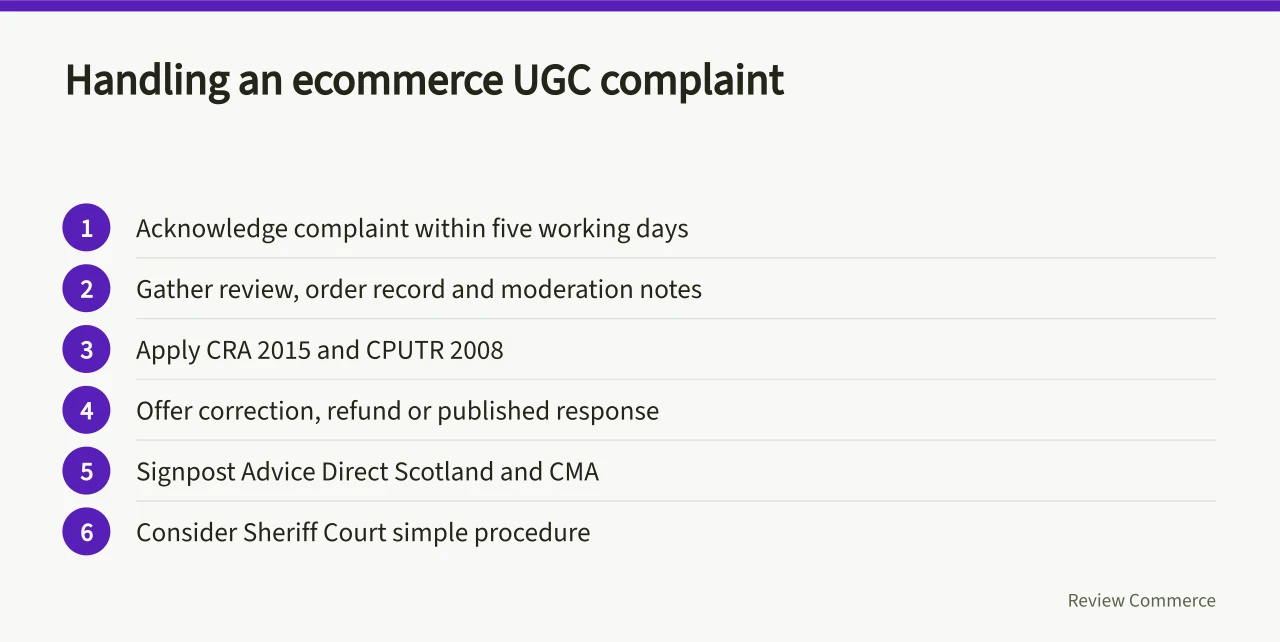
- Acknowledge the complaint in writing and identify the review or UGC in question.
- Gather and preserve relevant evidence, including the review, the order record and moderation notes.
- Assess whether the issue concerns a fake-review practice under the Digital Markets, Competition and Consumers Act 2024, a transaction right under the Consumer Rights Act 2015, or both.
- Explain the decision and offer any remedy the consumer is legally entitled to; do not promise publication or restoration of a review where there is no such obligation.
- If the consumer is not satisfied, signpost Advice Direct Scotland for consumer advice and explain that an eligible claim may be brought through Sheriff Court simple procedure.
- For enforcement concerns, give the consumer an appropriate route to local authority Trading Standards; concerns may also be reported to the CMA.
A worked example helps. Suppose a Glasgow retailer removes a one-star review that says a jacket was not waterproof. The consumer complains. The retailer checks the product description and finds the jacket was described as shower-resistant, not waterproof.
The review is genuine but appears inaccurate. The retailer can explain the product description in a reply and should apply its moderation policy consistently. Removing the review does not automatically give the consumer a right to a refund or to have the review restored; specific implement or retention would depend on an enforceable contractual obligation and the facts.
If the complaint escalates, the parties may agree to mediation. Scottish Mediation can help parties find a mediator; mediation is voluntary and is not a regulator, statutory complaints body or guaranteed outcome. The parties should agree any costs and process before proceeding.
Retailers should keep records that may be relevant to later disputes. Many contractual obligations in Scotland are subject to five-year negative prescription under the Prescription and Limitation (Scotland) Act 1973. This is not the same legal concept as the six-year limitation period that applies to many simple contract claims in England and Wales. For disclosure rules, see the commerce reviews disclosure policy guide.
Where Scottish consumer advice services fit
Advice Direct Scotland provides consumer advice. Consumer Scotland is the statutory consumer body, with a strategic role in representing and advancing consumer interests rather than resolving individual complaints. Trading Standards Scotland is the national trading standards body; local authority Trading Standards teams handle local enforcement work and can receive reports about possible breaches.
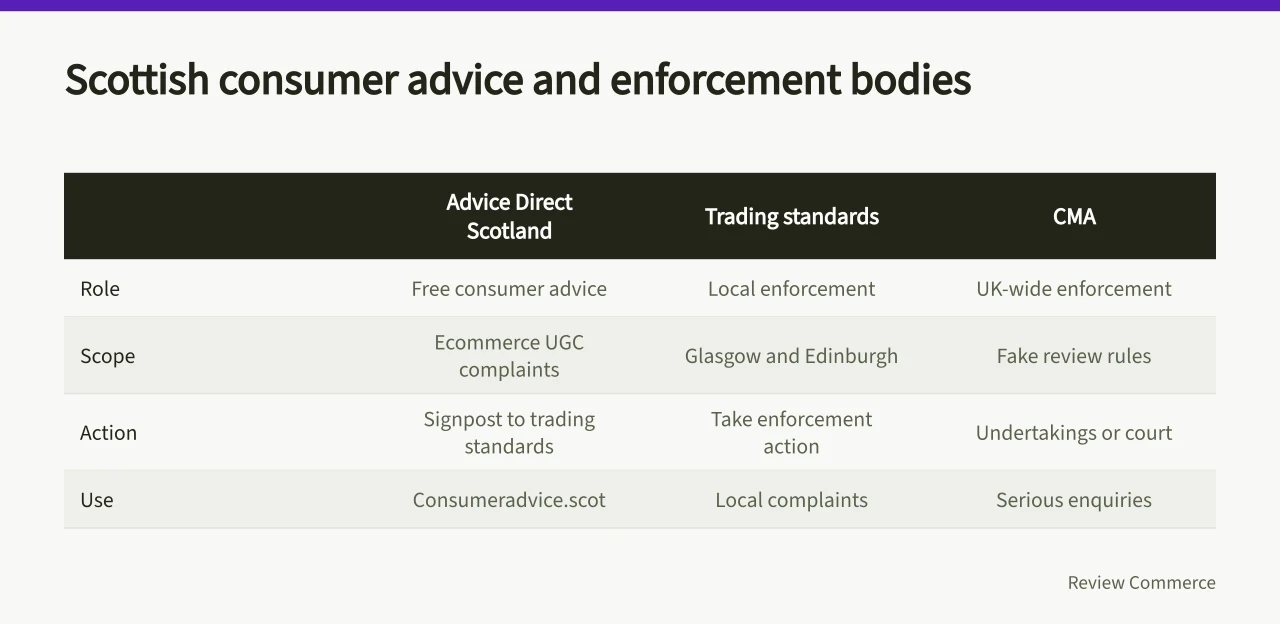
The Competition and Markets Authority (CMA) enforces consumer protection law across the UK, including the fake-review prohibitions in the Digital Markets, Competition and Consumers Act 2024. The Act gives the CMA direct enforcement powers, including powers to impose monetary penalties. Consumers can report concerns, but the CMA is not an individual complaints or redress service. For more on the fake review rules, see the related guide.
The Help for consumers - GOV.UK page explains the complaint and redress routes available to consumers.
For service standards, see the commerce reviews service standards article.